Showing posts with label United States. Show all posts

Monday, May 31

Protest Press Conference Scheduled Tuesday

PRESS CONFERENCE: FREE SPEECH ON THE PED MALL
Iowa City, IA – On June 1, 2010, Iowa City Council will be considering a third reading to reduce the free speech zone of the Ped Mall to appease business interests that lobbied its members. We find this to be abhorrent to the 1st amendment Rights of all Iowa Citians and ask the City Council to reconsider passing this ordinance. On June 1st at 6:30 pm in front of City Hall, Citizens United for Free Speech will have a press conference to present our side of the story. Members of Iowa Citizen's for Community Improvement, the ACLU, the Bill of Right's Coordinating Committee, FAIR!, as well as street performers and fund-raisers for non-profit groups who will be affected by enacting a more rigorous "aggressive panhandling" ordinance will also be on hand.

As of the release of this notice, the current ordinance has not resulted in the citation or arrest of one person that it was intended to address. Our group is calling for a review of the enforcement of the current ordinance and asks the City Council to delay the last reading of the ordinance until more facts that would justify the action are presented by those who desire the law changed. We will share our survey results (see: http://www.surveymonkey.com/s/J6LHR7G) that shows few Iowa City residents or visitors find the Ped Mall to be a dangerous place or unappealing to visit and because the impact for any group seeking goodwill donations will be permanently impacted by the Council's decision, believe this is a "solution seeking a problem."

Last month, the Mayor of Seattle, Washington, Bill McGinn, noted about the aggressive panhandling bill that he vetoed and his City Council backed up, "Although being asked for money on the street can be uncomfortable, it isn't illegal and the Supreme Court has said repeatedly that this is protected speech." He also noted his concern that the law would be leveraged unfairly against those who were perceived to be a threat. We share his concerns.


Reblog this post [with Zemanta]

Wednesday, May 12

Manhandlers or Panhandlers?

As the Iowa City Council will have one more vote on the extended panhandling ordinance tentatively on June 1st. Fair-minded people should ask: which is more dangerous, a panhandler with a sign or a city council that can't be swayed from a decision that they clearly do not have evidence to support the need of? The violations of the current aggressive panhandling ordinance has been numbered at zero--ZERO. This is governance of the worst sort: a solution seeking a problem.

Thankfully there are others in the Iowa City Community who share this concern and continue to organize around defeating the proposition.

If you are a resident of Iowa City or a visitor who has been on the Ped Mall, drop a note to the city council, if you share the concern that the city government is over-stepping it's bounds. Further, write a letter to the local papers and show up at the meeting. Let the government know that Iowa City is for everybody.

Reblog this post [with Zemanta]

Sunday, April 25

Who Is the Party of the MOTR?

It appears from the conversations and so on that I've had with people who attended the Democratic and Republican Party district conventions that some didn't feel very well respected. Been there, done that. Political parties by their natures are fairly incestuous and are not really looking for new ideas, but rather new ways to sell the ideas they already have.

Let's talk about you and me. Most people are not party joiners, though we tend to affiliate to one or the other of the D or R parties at least once every few years. Every election we are told is decided by the "middle." And for this reason I would argue it is this way because the middle doesn't have a party of our own; hence the other two prevail.

Anyone who has tried to join one of these parties soon comes to realize that it is hard to accomplish substantial movement. Why? Because the parties' hierarchy know what has worked for them and, frankly, both major parties are arch conservatives when it comes to moving away from their sacred cows.

So why not just join an established third party? Once again, the doctrine is drawn. As John Mellencamp, Malcolm X, and Alexander Hamilton all sort of said, "If you don't stand for something, you'll fall for anything." All parties stand for something, but none stand for what most people think is right. Hence we are a nation of flip-floppers who go back and forth generally between D's and R's.

Early in our nation's heritage, choosing between two was quite a step up from Monarchy. However, I think that many people agree that neither party really represents what main street or the mainstream think. In fact each party claims to feel our pain, but in reality, they are counting up our votes.

So why not join the Tea Party? Well, who is the Tea Party and do they represent mainstream values? According to the Tea Part Patriots' website they stand for:


Fiscal Responsibility: Fiscal Responsibility by government honors and respects the freedom of the individual to spend the money that is the fruit of their own labor. A constitutionally limited government, designed to protect the blessings of liberty, must be fiscally responsible or it must subject its citizenry to high levels of taxation that unjustly restrict the liberty our Constitution was designed to protect. Such runaway deficit spending as we now see in Washington D.C. compels us to take action as the increasing national debt is a grave threat to our national sovereignty and the personal and economic liberty of future generations.

Constitutionally Limited Government: We, the members of The Tea Party Patriots, are inspired by our founding documents and regard the Constitution of the United States to be the supreme law of the land. We believe that it is possible to know the original intent of the government our founders set forth, and stand in support of that intent. Like the founders, we support states' rights for those powers not expressly stated in the Constitution. As the government is of the people, by the people and for the people, in all other matters we support the personal liberty of the individual, within the rule of law.

Free Markets: A free market is the economic consequence of personal liberty. The founders believed that personal and economic freedom were indivisible, as do we. Our current government's interference distorts the free market and inhibits the pursuit of individual and economic liberty. Therefore, we support a return to the free market principles on which this nation was founded and oppose government intervention into the operations of private business.

Up to point number three, I could get behind those principles. In fact, taken with point number two, we really can't have a free market. Why, because the Constitution tells us we need taxes and those taxes are haggled over by those whom we elect. A so-called free market can't exist as long as we ask people to pony up money to have a government do things for us.

So, no Tea Party for me, and I doubt for many folks who are happy to have trash pickups, clean water, aid to families with dependent children, social security, etc. Also for those who aren't willing to lose arms and legs working in uncontrolled manufacturing plants and don't pay a living wage.

So what would the Middle of the Road Party look like? Beats the heck out of me. We haven't had our convention, chosen our leaders, or created our platform. There is not a party and so the climb is long and the odds are against us.

If I were to venture a guess, the MOTR party would place the future of kids at the forefront. It would tend to be hopeful, but cautious in what this country does both here and abroad. It would insist that rules were enforced, but the rules were fair in the first place. It would be a party that celebrates pragmatism--where some change would come fast and others a little at a time. It would not seek to win by putting the other parties down, but to win by articulating the things that people believe are in the best interest of the country, even if they aren't always in the immediate best interest to themselves. Yes, it would uphold the Constitution. And, of course, it would be fiscally responsible.

I also believe it would be hard to build. It would ask people to disengage from the politics they understand to be how things are done and engage in conversations with people in a way that doesn't make me right and you wrong. It would put us in a whole new place. It would be a bold venture to be sure.

Reblog this post [with Zemanta]

Thursday, March 25

Dear Mr. President: Learning from the Past

Portrait of President Harry S.Image via Wikipedia

Dear President Obama,

You promised change and you have begun to deliver on that promise. By signing the Health Care bill, you have given people who have gone without health insurance the opportunity to be healthier and those who have been ill, the ability to once again have access to care without the onus of becoming bankrupt. And these are good steps.

Harry Truman believed that all Americans should have access to health care as a right and Lyndon Johnson signed legislation that allowed the elderly and the poor to have access. With uncertainties in the economy, it is impossible to know when any of us will be without work for extended periods of time. So thank you and Congress for making this first step.

Having said this, can a for-profit health insurance industry ever really sustain affordable health care for all? Chances are there will be future trade-offs to improve what has been signed into law. More important, will the need for health care providers be met and incentivized? Access to health care is great, but it also requires enough doctors, nurses and other allied health practitioners to be trained.

Beyond health, there is a general unease in the country. A general belief that we are in over our heads financially and, perhaps, politically. From the local school board to D.C., the message is one of "live within our means." The problem is, we as Americans have made bad investments--in the stock market, in banking, and in wars.

If ever there was a need for the type of leadership that people thought they would get by electing you is crucial, now is that time. FDR had it right with his fireside chats. He understood that people were distrustful of their government, but desired a personal connection to their elected Commander-In-Chief. In the age of the 24 hour news cycle, I do not know how it is possible to command the national stage like FDR did, but I do know that you can and must make every effort.

And you need support. I don't know why it is impossible for political adversaries to put party aside in doing the people's business at this very difficult period of our history, but it is clear that there can be no good that comes out of selfish, petty party politics. The same is true of grassroots movements that are short on solutions and long on vitriol.

The one thing that is certain is we only have one President at a time and that person deserves our respect regardless of whether we agree with all of his or her decisions. Conversely, the person in office must convey to the American people where he or she feels we are going and their roadmap to help us get there. You are a particularly gifted communicator. Communicate.

Musician Pete Seeger has a saying on his banjo that says "This machine surrounds hate and forces it to surrender." Those of us who value moving forward with hope need to be rallied to oppose those who are living in fear of what our country will become. The late Paul Wellstone said, "The people of this country, not special interest big money, should be the source of all political power. Government must remain the domain of the general citizenry, not a narrow elite." I think people on all ends of the political spectrum question whether this is the government we have.

I truly believe that those who question what has been happening in government mean well and are genuinely concerned for their and their children's future, but are allowing their uncertainty to cloud their thinking about what is best for the country. Ronald Reagan, for all of his faults, did one thing exceptionally well. He had the ability and gravitas to convince folks that the sun hadn't set on the USA--it is now your responsibility to remind all citizens that this is still true.

In faith,

Garry Klein
Popular Progressive

Reblog this post [with Zemanta]

Wednesday, February 24

Future of Government: Evolution or Intelligent Design?

Where we have arrived as a nation is a disdain for the Government we have elected, appointed, and volunteered to be a part of. But really, is it in lousier shape than say during the Civil War? In reality, the times we are now are experiencing is a lack of cohesiveness about national identity. Resistance to taxes, the belief that the government is creating more problems than it is solving and so on are a symptom: we don't know where we are going as a nation.

In the good old days of manifest destiny, we could spread from coast to coast and there was plenty of reward to be reaped by all who were of God-fearing and descended from European stock. After the world wars, we continued our ascent through economic growth and industrial colonization. But with that came the need to underwrite favorable governments' leaders and prop them up with our military materiel and cash. And that was and is an expensive proposition particularly when you send in our troops to back up those leaders.

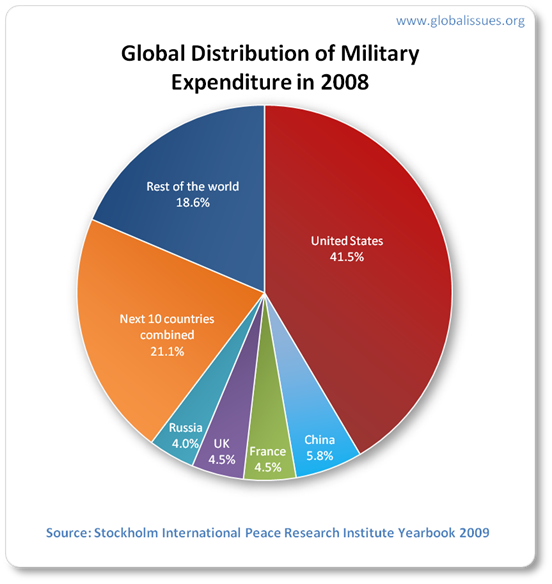
Our national debt has grown as a result of growing our military (roughly $800 billion per year), $$383 billion in interest on debt, and 1.3 trillion on medicare and social security.


This part of government growth we could call Intelligent Design -- simply doing God's will so that He/She would continue to bless us with greater abundance and allow us to be the great "exception". We would be the lantern that all other nations would turn toward, as heathens would turn to Jesus and our brand of Capitalism.

However fortunes favor those who have control of the economic supply chain and have lots of room for market growth--and that is no longer our strongest suit. We have to share the stage with burgeoning economies that are percolating in India and China and other places. Plus our balance of trade is badly out of whack as we continue to import more than we export (the trade deficit widened to $40.2 billion in December 2009 from $36.4 billion in November).

As corporate interests have paralleled government interests, one might question the incestuous nature of that relationship and wonder how government will evolve if the pattern continues. We have all borne witness to how the private sector has branded itself on public buildings and in government agencies. Imagine the world order if corporations are brokering deals between nations? Oh wait they are (See: World Trade Organization).

As both the left and right are becoming increasingly angered by the corporate and government pick-pocketing that they perceive happening, it stands to reason that there are two prime possible choices for the Government. Either Government reforms itself or Government represses dissonance. We will have to see how that "hopey changey thing" turns out. Of course, we have a lot to say about it.


Reblog this post [with Zemanta]

Tuesday, February 16

Chet Culver Needs to Get Out More

While out of state in Ohio this past weekend, I felt badly for missing Gov. Culver's visit to the Hamburg Inn for a chat with The People. Having not supported the Big Lug when he ran against Ed Fallon in the last go round, I am not particularly surprised at the way his first term has gone. When I attended the Labor Day picnic and watched him spend most of his time pitching E-85 to members of local unions, I thought, this guy really doesn't care about his audience much. And, given his insular behaviors as Governor, it should not be surprising that he is likely going to be fighting the campaign of his life, if he is to be re-elected--and this is sort of sad with the stellar group he is up against.
But, as a Democrat in a state that needs to create and save jobs, Culver has been remarkably disappointing. First, because he has bitten the hand of labor that helped elect him (though very recently threw them a bone)and, second, by a lack of creativity to use the resources he has at his disposal to improve the welfare of the state. For instance, why has the "reinvention" of state government not been a "day one" priority? Why did he call for 10% across the board cuts to agencies when some agencies are of higher priority than others (e.g., anything having to do with human services)? Why hasn't the Governor negotiated with AFSME for salary cuts in lieu of forced-retirement? And in offering incentives for retirement, why hasn't the state at least required retirees to live in Iowa for the 5 years that the state is paying their health benefits?
And I won't go into the failures on agriculture, the environment, but to say that Culver hasn't lived up to his campaign promises on these two fronts. Iowa has massive potential to feed and fuel itself, but to do it sustainably has been the trick. Monsanto and ADM have done well for themselves under Culver, but not the local family farmer or those who would grow organics. Part of this, of course, is in part because of Secretary of Agriculture, Bill Northey, but the Chief Executive of the state has a lot to say about policy.

Reblog this post [with Zemanta]

The Political Landscape: A Receding Hairline?

While glancing at the mirror the other day, I had the feeling that my hairline and the current state of American politics have a lot in common: hairy on both sides and empty down the middle. Yeah!--Huh? Follow along.

The real Left and real Right are angry and looking for leadership to help them coallesce. In the meantime, like my hair, they fire shots across the bow of each other. The central point of agreement is that it is all Obama's fault--either for not using taxes for the right things or for taxing them at all. In both cases, they are missing the point--left/right division doesn't get anything done, the Middle does. However when it comes to nominating politicians, the Left and Right know that's where they have a significant say and are actively pushing from the grassroots (or the hairline, if you will).

The Middle knows that there is something going on but, with trying to hang on to the job, the marriage, and taking the kids to assorted activities, who has time to pay a whole lot of attention? What they are paying attention to is the feeling that their lives may change--or not, depending on what happens in 2010--for reasons they don't quite get yet. They don't know for instance whether Obama is a "Radical Socialist" or if Republicans are the "Party of No," but they do worry whether they will be okay and their kids will be okay. The Tea Party Nation doesn't speak to them, but neither does Noam Chomsky.

Typically during the election cycle, the Middle does what I used to do with my hair, push it to the right or left for maximum coverage. I wonder if a real Independent Movement would be to go after the Middle, find out what it cares about and form a party around it? A real populist movement, not one formed by anger on the edges, but based on practical politics--a chicken in every pot sort of stuff. If this movement should happen, I wish it more success than my hair. But, I do know that my right and left hair-mispheres will not be coming together anytime soon.

Reblog this post [with Zemanta]

Monday, January 18

I Have a Dream: The Party Is Over

In my years being involved in the political process, I believed that party membership had it's privileges. However today, I am convinced that while I can and will support individual candidates for public office, my days of valuing party membership are nearing their end. And this is why.

As any reader of this blog knows, I am a populist progressive. I believe that both parties are in dire need of embracing their grassroots and moving their agendas forward in a way that benefits people. As Paul Wellstone, the late FDL Senator from Minneaota said, "Politics isn't about big money or power games; it's about the improvement of people's lives." Clearly this is not the environment that we are in today.

I believe that the far Right has recognized this and it's Tea Party is a movement that feeds off the frustration that people have in mistrusting the government. Troubling is that the feeding of mistrust has burned from raw emotion and does not rely on much fact.

The far Left, on the other hand, is reeling in bitterness over helping to elect a President and Congress that may only slightly better than its predecessor on important issues. The left is not short on emotion either, but does value good information to make decisions from.

In following the debate on health care reform, it has become imminently clear that a world-class health care program for those without access will not happen and it is not because of demand or good information, it is because of ham-fisted politics. As long as those interests who fund campaigns and write legislation continue to hold sway, it does not matter which party is in power.

On this, the eve of Martin Luther King's birthday, I have a new dream. I dream of a multiparty democracy where no two parties can accomplish their will without collaboration from a third and/or fourth party. Said differently, it is in the national interest of this country to end our dependency on the two party system.

I have a dream that our children and grandchildren will support candidates from the Green Party and Socialist Party, as others support Natural Law or Libertarian candidates. I may not be there to see it with you, but I'd look forward to the seeds being sown in my lifetime.

I have a dream that a Green President will have to negotiate with a Republican/Libertarian majority House, and a Democratic/Socialist majority Senate.

My guess is it will create a challenging environment to get the People's business done, but I also believe that better legislation will come out of it. I also believe that people who have a genuine commitment to public service will step up and true progress can be made.

I look forward when the character of one's soul holds more sway than the letter on the person's voter's registration card. If we can arrive at a place where we can deal with our problems in ways that benefit people, we will be, in the word's of the spiritual, "Free at last, free at last..."

Reblog this post [with Zemanta]

Wednesday, December 2

Obama's Resurgance in Afghanistan

In an elegant show of reasoning and logic, President Barack Obama, with his security team in tow, spoke in front of 3400 West Point cadets and explained why he was committing 30,000 more American troops to the War in Afghanistan beginning in January 2010. Despite his reassurance that the war will be limited to:
• Denying al Qaeda a safe haven
• Reversing the Taliban's momentum to overthrow Afghanistan's government
• Strengthening Afghanistan's security forces and government,
what is being repeated is a surge policy. With the idea being to have enough boots on the ground to finish what has been, to this point, a largely unwinnable war, his hope lies in repeating the relative success that his predecessor's policy had in Iraq.

To his credit his plan has a timeline, but like all war plans, there is an escape clause depending on what is happening in the country when the withdrawal of troops is scheduled to start in July 2011. The plan also includes commitments from 43 countries to step up and support the effort, which is commendable if it works. Lastly, Obama pointed out that the extra $30 additional billion price tag per year will have to be paid for and that he would work with Congress to do that. With the current plans to overhaul health care and to invest in job creation, one has to wonder what will be cut to accommodate two wars that have already cost taxpayers over a trillion dollars.

As the President travels to Oslo to accept the Nobel Peace Prize in nine days, one has to wonder if he should decline the honor. To accept such a prize under the shroud of escalating this war is tragic, regardless of his reasoning for doing so.

Reblog this post [with Zemanta]

Thursday, October 8

Jobless and Workers Getting Mixed Messages From Senate

With the benefits for Iowa's unemployed expiring, the US Senate continues to quibble over who should qualify for an extension of benefits. Here's a suggestion: everyone who is unemployed and actively seeking work or retraining.

The conflict over whether "high unemployment states" should be the only one's receiving Washington's largess, will be lost on every worker who is left out. The House didn't seem to have any problem seeing this logic, perhaps Senators need to get out more often.

At least one Senator seems to get it, Jeanne Shaheen, D-N.H., is planning to introduce a measure that would extend jobless benefits in all 50 states by 17 weeks.
"Distinctions in state unemployment rates may make sense in Washington, ... and they don't make sense to the 15 million unemployed workers nationwide who are struggling to get by and get back to work," said Shaheen.

Meanwhile The U.. Supreme Court has made a ruling regarding older workers that is likely to make it easier for employers to discard or demote them. The court raised the burden of proof for demonstrating age discrimination, ruling last term that a "mixed motive" including age as a factor was not strong enough evidence. Senators Tom Harkin and Pat Leahy are working with Rep. George Miller to pass legislation that would require employees to only prove that age had been a "motivating factor" in their termination or demotion.

According to the Wall Street Journal,

the Senate also addressed the effects of the court's opinion in Circuit City v. Adams, a 2001 decision that enlarged the reach of employees who are required to address disputes through arbitration rather than through the courts. At the hearing, Jamie Leigh Jones, who had worked for a former subsidiary of Halliburton (HAL), argued that arbitration can prevent important information from entering the public record. Jones said she was drugged and raped while working in Iraq in 2005 and has spent the past four years trying to get her case heard in court rather than in the arbitration she agreed to when she was hired.

"It's very apparent to me that corporations adopt arbitration as a way to wipe clean the record of disputes that arise," she said.

Sen. Al Franken offered an amendment to a defense bill that would restrict funding to contractors that require their employees to go through arbitration to settle sexual assault claims. In April, Sen. Russ Feingold, D-Wis., introduced a broader bill seeking to invalidate many binding arbitration clauses and return consumer, employment and civil rights disputes to the courts.

When Mark de Bernardo, executive director of the Council for Employment Law Equity, defended the use of arbitration as a faster and cheaper alternative to litigation, he faced sharp questioning from Franken.

"You said the net result of the use of arbitration is better workplaces," Franken said, cutting off de Bernardo's response. "She was drugged, she was raped, she had to have reconstructive surgery. If that's a better workplace, what was the workplace like before?"


Reblog this post [with Zemanta]

Monday, September 14

Weighing the Public Option V. Health Care Cooperatives

Because of increasing pressure from both the right and left, Congress is in the position of either a public option for health care reform, a private health care consortium/cooperative, or not doing either and adding a trigger mechanism that would kick in if the private sector failed on benchmarks to ensure all Americans have access to affordable health care. I have written about the public option in general and will compare the benefits of it against the cooperative and exchange options. Finally, I will discuss the trigger option.

According to Consumer Watchdog.Com "a carefully constructed “public option” to private insurance would provide an antidote to the market consolidation that has propelled premium increases and administrative inefficiencies, shrunk coverage and degraded quality. However, it can only succeed if it:

• Provides all Americans access to the largest risk pool possible. Universal access to Medicare provides the best option.
• Includes new regulation of private insurers to level the playing field with the new public option–namely guaranteed issue, community rating, and a guaranteed base benefit.

The option to join Medicare, regardless of age, would be beneficial to Americans because by almost every measure, Medicare is cheaper and more effective than private plans, according to government and academic research. For example, Medicare spends 2% of revenue on overhead; private insurers typically spend 25% to 27% for overhead and profit."

Opponents of the public plan say that the public option would drive private insurers out of business. However the Congressional Budget Office estimates that no more than 10 or 11 million people or 3.6% of the current US population would be enrolled in any public option by the year 2013. The only private insurer that would be driven out of business would be those that are offering marginal plans to those without insurance right now. Hardly seems like a loss, particularly from a consumer's perspective.

The cooperative model as proposed by Sen. Kent Conrad could be formed statewide or in geographic regions. They would be the insurer that would contract directly with health care providers, and like Group Health, would be self-governed by an elected board. Startup money could come from the federal government through grants or loans. At present, there are two such co-ops in the US, Group Health Cooperative of Washington and Health Partners in Minnesota.

The other type of cooperative or exchange is an insurance cooperative where middlemen would shop for the best insurance rates and options from private insurers and make them available to the public who enroll in the cooperative.

The supporters of the two types of programs insist that the free market will respond better if the government is not involved. Unfortunately, the facts seem to suggest that larger insurers pick and choose where they will insure and the costs of insurance to those in marginal markets are higher than elsewhere. For the health care cooperative there is the additional issue of being locked out by hospitals and doctors who can get a better deal from the health insurer giant in their area.

Those who are not sure any additional competitors are needed, that insurers need to be forced to guarantee coverage even for those with pre-existing conditions, say that what is needed is a government trigger. If private insurers are not providing universal, affordable coverage that then is when other additional options should be considered. On a common sense level this sounds good, but the period of time for the trigger options are proposed to be three or four years into the health care reform plan. This would likely mean that some people could be without insurance for five to seven years.

If the United States is serious about creating coverage options and keeping down the costs of providing care, the mine field of how to cover citizens will have to be crossed. By spreading costs out over more people, all Americans are likely to have lower costs in the longer run.

Reblog this post [with Zemanta]

Saturday, June 20

Universal Health Care Now!

I've been taking some time away from blogging because, let's face it, problems never really go away and everyone needs a chance to chill out. In my absence, the national health care debate rages on. Many people actually thought there was a national health care bill ready to go when President Obama was elected. Certainly his plan was shopped publicly when he was running for the office. But apparently there is not a "shovel-ready" health care bill or enough money to pay for the bill, depending on who you ask.

This is my solution. No holidays for Congress until a bill is forwarded for the President's signature that makes sure that 100% of Americans have access to affordable health care. At this point I don't care if it is a single-payer or gazillion-payer model, just that it is universal and affordable to all.

As for those Congressional leaders who line up he pieces on the chess board who need to get this done, lock down Capitol Hill and take your fellow public servants off the grid. This means no lobbyists, cell phones, or computers (except in the capable hands of the recorders who will write up the final bill). No tweeting, crackberry texting, facebooking, etc. Clearly this bunch is overly distracted and needs time to focus. If necessary, cut off the air conditioning (think of it as reliving the Continental Congress).

The point is that health care is the one thing that is needed by every worker and the thing that American industry claims keeps it from being competitive globally. If we really want to rev up the economic recovery machine, make sure everyone has the opportunity to be healthy--even corporate personages.

Trial lawyers, unions, big biz, doctors, and insurers beware, you can not dictate the discourse on this issue any more. You had your chance. If you are found within 100 miles of the halls of Congress, you should expect to be deported to Palau (we should at least get our money's worth out of that deal). We know you have been assailing us with your ideas of what is best for us, but really, it is always about what is best for you.

We the people are sick of being sick because the pursuit of profits are involved. We want health care as a fundamental right--after all what is the pursuit of happiness if you can't get out of bed to pursue it?

So listen up Congress--drop everything else you are doing and get this legislation done. If it isn't perfect coming out of the gate, don't worry about it--we'll make you keep working on it until it is or elect people who can. Congressmen Braley, Loebsack, Boswell, Latham, and King and Senators Grassley and Harkin, this means you.


Reblog this post [with Zemanta]

Thursday, April 30

Obama Hits A Home Run

It is hard not to praise Barack Obama for his press conference last night, particularly when you compare him to his immediate predecessor. The difference in the level of candor he showed in addressing his presidency's first 100 days were markedly different than President Bush. In discussing the state of the economy, his views on abortion, whether "enhanced interrogation techniques" qualified as torture, concerns about the Taliban in Pakistan and on and on, Obama spoke openly and directly.

When a NY Times' journalist asked him to address the things that surprised him, troubled him, enchanted him, and humbled him, President Obama carefully wrote the request down and thoughtfully addressed each point.

Surprised: Obama professed surprise, and not a little dismay, by "the number of critical issues that appear to be coming to a head all at the same time." Most presidents he said deal with 2 or 3 things and his administration was dealing with 7 or 8 things.

Troubled: Obama said he was "sobered by,"The fact that change in Washington comes slow. That there is still a certain quotient of political posturing and bickering that takes place even when we're in the middle of really big crises." He added, "I would like to think that everybody would say, you know what, let's take a timeout on some of the political games, focus our attention for at least this year, and then we can start running for something next year. And that hasn't happened as much as I would have liked."

Enchanted: He and the press corp laughed at the word choice, but said he was "profoundly impressed and grateful" when he thought of his interactions with the men and women wearing the military uniform of this country from the "top brass to the lowliest private."

Humbled: He said his sense of imposed humility comes from the fact that the presidency, in all its glory, is only "part of a much broader tapestry" in a nation with many different centers of power. "And so I can't just press a button and suddenly have the bankers do exactly what I want, or, you know, turn on a switch and suddenly, you know, Congress falls in line."

For his critics who say that he wants the government to interfere with business he made the point around the government's current role with the automakers that he hoped to help them be competitive and said he really didn't want to be in that position for long because "I've got two wars I've got to run already." He went on to say that the government shouldn't micro-manage these companies it essentially owned, pointing out that he himself is not an auto engineer.

Finally, in summarizing he said "the ship of state is an ocean liner; it's not a speedboat." That he would work as hard in the next hundred days and all the hundreds of days to follow to put the country back on course.

Reblog this post [with Zemanta]

Sunday, April 12

Iowa Soldier Among Dead in Iraq

As the U.S. gears down in Iraq to shift resources to Afghanistan, on Good Friday, 20 year-old Corporal Jason Pautsch, a squadron leader from Davenport, four other US soldiers, and two iraqi Security Force members were killed by a suicide bomber in Mosul. The bomber drove a grain truck with 2,000 pounds of hidden explosives into a security wall of the national police complex there killing the soldiers and injuring at least one US soldier, 27 Iraqis and 35 others.

Cpl. Pautsch had been in Iraq since last September. He was scheduled to come home next month for a few weeks then finish his tour of duty in October. Members of his family traveled to Dover Air Force Base in Delaware to be there when his body arrived on Saturday.

The Quad-City Times reports that his father David said “Jason just called Thursday at two o’clock, and we talked an hour. Twelve hours later he’s dead.” Pautsch, who is the president and CEO of L.W. Ramsey Advertising Agency and the founder and executive director of Thy Kingdom Come Ministries, said that he never let himself think that his son could be killed in action. “Maybe I was in denial. I thought for sure he’d come back in flying colors, live a long life and die of old age.”

The Associated Press reported that U.S. troops must leave the city by June 30 under an agreement with the Iraqis. About 2,000 U.S. troops and 20,000 Iraqi army and police officers are stationed inside Mosul.

The total casualties in Iraq for American troops and Iraqi civilians are 4271 and between 91,385 – 99,774 respectively. Pautsch is the second Davenport area soldier to die, Katie Soenksen was killed in 2007.
Reblog this post [with Zemanta]

Iowa in Top 10 for Dead Zone Creation

Thinking globally and acting locally has an important meaning as it applies to the water quality in Iowa. According to the U.S. Geological Survey in it's first report measuring the effects of nitrogen and phosphorous runoff on aquatic life downstream, 9 states contribute over 70 percent of the dead zone-causing nitrogen and phosphorus pollutants. They are: Illinois, Iowa, Indiana, Missouri, Arkansas, Kentucky, Tennessee, Ohio, and Mississippi.

In January 2008, USGS identified commercial fertilizers and animal manure from farmland in these nine states as the cause of over 70 percent of the Dead Zone pollution. Evidence is mounting that the mandated push to increase corn production – one of the most fertilizer intensive crops – for ethanol exacerbates water quality problems within the states and in the Gulf. This year, the USGS identifies and ranks watersheds in the Basin by the amount of pollution that gets to the Gulf.

The U.S. Geological Survey also has released a new list with 42 Iowa watersheds among the top 150 that are polluting the Mississippi River Basin and contributing to an 8,000 square mile "dead zone" in the Gulf of Mexico. That list is reinforcing the opposition of environmental and farm groups to legislation that would allow large Iowa farms to continue a practice of spreading liquid manure on ice-and-snow-covered ground in winter.

Among the 42 Iowa watersheds with the most serious nitrogen-loading and drinking-water problems are the Cedar and Des Moines River watersheds.

The Iowa House is expected to debate SF-432 this week which deals with the dumping of hog containment waste into the waterways.

More here and here.


Reblog this post [with Zemanta]

Sunday, April 5

It Takes a Nation of Millions to Get Important Things Done

With the national unemployment rate reported at 8.3% and states like California, Oregon, North Carolina, South Carolina, and Michigan in the 10%+ category, are we moving beyond the realm of recession? If history tells us anything, during the great Depression, the national unemployment rate in 1930 climbed from 3.2 to 8.7 percent. By 1931, the unemployment rate went to 15.9% and by 1933, it rose to 24.9%.

The better news for us is that many of the safety nets in the securities and banking industry were installed as a result of the earlier depression. It is important to say that statistics lag behind reality so it is likely we will see poorer employment and GNP numbers before they go the other way. The one thing that is for sure is that job creation should be our number one priority and those jobs should be in the sectors that enhance human and structural infrastructure, reduce oil dependency, and reduce our carbon footprint.

Regardless of the economy of today, the bigger picture tells us that we need to change our business models to reflect the state of the world as it is and as it will be. Stabilizing banks and the auto industry without a thought of where the economy should go is short-sighted. With all of our taxes being gambled, the least that the government should do is demand that the money be utilized in the development of the next economic engines, e.g., electric or other alternative fuel vehicles, mass transportation, wind and solar power and improvements to the electric grids.

Money should also be invested in a nationally-networked health care system to which everyone has access. As long as health costs are keeping businesses at all levels from investing in research and development, job creation will be difficult to sustain.

Also, we need to move away from and "us and them" mentality when it comes to jobs. I have long been a supporter of unions, but I recognize that perhaps more could be done for the quality of life for workers of this country if liveable wage legislation were the tool for getting there. Then the time spent by management and workers could be focused on developing needed high quality products and services.

Finally education needs retuning. As long as we don't acknowledge that public education has a multi-purposed agenda: to have a highly literate, skilled workforce, to blend cultures to develop equity, and to form social tolerance through shared experience. However, what is lost in the picture is that schools of today must be more focused on the task of fundamental education at the lower levels and vocational preparation at the higher levels. Ultimately local school boards and workforce/economic planners should be engaged to have curricula that stress the practical as well as the intellectual needs of its community.

In these topsy-turvy times, we can choose to see our future as one where the sky is falling or we can see it as things are looking up. The one thing that is certain is that the rules of the game are changing and we need to look forward for the answers and we need everyone to pull in the same direction.

Reblog this post [with Zemanta]

Sunday, March 15

How to Right-Size Government

Government is necessary, really it is. Can you imagine what life would be like if people did whatever they liked, whenever they liked? Those folks who don't believe in evolution would get a big taste of "survival of the fittest" if there weren't rules in place and a body to enforce those rules--and history bears this out. However, the real issue is how big is big enough where governments are concerned?

Clearly there is a wide divergence of opinion on this subject from anarchy to dictatorship, but even toward the relative middle, there is a gulf between what is "fair" government. For some, the totality of government worth is tied to the amount of taxes that are extracted from them. For others, it is the perception of how safe their government makes them feel. For others, it is the use of government policies and their taxes to do the things that the private sector is unwilling or unable to do that produces equity or fairness.

As we are a representative democracy, it is not always practical for the electorate to vote on whether their tax dollars are being spent wisely or if laws are agreeable to the majority. In fact the way that the Constitution works assures everyone that whether they are in the majority or minority, their rights will be protected. Still, the powers that be in a locality, a state, or the federal government need to be informed by the citizenry and this is good.

To the point at hand. Do we need government to be small enough to drown in a bathtub or big enough to fill an Olympic-sized swimming pool? That is and probably always will be the million dollar question. I propose some "rules" for deciding if the government that affects you most is the right size:

1) Does the government deliver what it promises? For example, if a tax referendum occurs do the items the tax is raised for actually get paid for or are other unspecified projects moved up the list after the vote?

2) Are decisions made by the body a result of a desire of efficiencies or turf protecting? For instance, if an efficiency can be created by cooperating with other governmental bodies or with private interests, does it happen?

3) Are more people helped or hurt by the decisions that the government makes? This one is a hard rule to enforce because "help" and "hurt" are in the eyes of the beholder. My thought is if the rights of all are protected by an action, then do it.

4) Is the action taken by the government beneficial to the community it serves more times than not? In this regard I don't mean that you agree with every decision they make, but merely that the decisions made are intended to support the well-being of the community.

5) Could the job be done with less governance? Does a state need to create an agency when a oversight board would be as effective?

6) Does the government get in the way of people negotiating with those they have grievance with? Labor/management relations comes to mind on this point.

Certainly there could be other rules or a different way to right-size (e.g. determined by tax-rate formula). I leave that to your comment.


Reblog this post [with Zemanta]

Tuesday, February 10

Obama Press Conference: Refreshing Differences

After the Bush years of obfuscation, a unusually somber President Obama should receive high marks for relative candor and a high degree of control in his first televised national press conference. Faced with a financial crisis with a second bailout and stimulus package up in the air, Obama made his case to the American public while deftly addressing questions put to him by the press.

For example:

Chip Reid: You have often said that bipartisanship is extraordinarily important, overall and in this stimulus package, but now, when we ask your advisers about the lack of bipartisanship so far -- zero votes in the House, three in the Senate -- they say, "Well, it's not the number of votes that matters; it's the number of jobs that will be created."

Is that a sign that you are moving away -- your White House is moving away from this emphasis on bipartisanship?

And what went wrong? Did you underestimate how hard it would be to change the way Washington works?

Obama: Well, I don't think -- I don't think I underestimated it. I don't think the -- the American people underestimated it. They understand that there have been a lot of bad habits built up here in Washington, and it's going to take time to break down some of those bad habits.

You know, when I made a series of overtures to the Republicans, going over to meet with both Republican caucuses, you know, putting three Republicans in my cabinet -- something that is unprecedented -- making sure that they were invited here to the White House to talk about the economic recovery plan, all those were not designed simply to get some short-term votes. They were designed to try to build up some trust over time.

And I think that, as I continue to make these overtures, over time, hopefully that will be reciprocated.

But understand the bottom line that I've got right now, which is what's happening to the people of Elkhart and what's happening across the country. I can't afford to see Congress play the usual political games. What we have to do right now is deliver for the American people.

So my bottom line when it comes to the recovery package is: Send me a bill that creates or saves 4 million jobs. Because everybody has to be possessed with a sense of urgency about putting people back to work, making sure that folks are staying in their homes, that they can send their kids to college.

That doesn't negate the continuing efforts that I'm going to make to listen and engage with my Republican colleagues. And hopefully the tone that I've taken, which has been consistently civil and respectful, will pay some dividends over the long term. There are going to be areas where we disagree, and there are going to be areas where we agree.

As I said, the one concern I've got on the stimulus package, in terms of the debate and listening to some of what's been said in Congress, is that there seems to be a set of folks who -- I don't doubt their sincerity -- who just believe that we should do nothing.

Now, if that's their opening position or their closing position in negotiations, then we're probably not going to make much progress, because I don't think that's economically sound and I don't think what -- that's what the American people expect, is for us to stand by and do nothing.

While not always answering questions head on, like in the case of whether he would reverse the policy about allowing the photographing of the draped coffins of soldiers returning to Dover AFB, he did say what criteria he would use to make his decision.

Perhaps one of his best and worst moments was in addressing the grand lady of the press, Helen Thomas, for the first time as President when he smiled and said "All right. Helen? This is my inaugural moment here. I'm really excited." Thomas, who was relegated to the bullpen during the Bush administration, didn't give him a pass in asking him "Mr. President, do you think that Pakistan and -- are maintaining the safe havens in Afghanistan for these so-called terrorists? And, also, do you know of any country in the Middle East that has nuclear weapons?"

His response was somewhat evasive when it came to the second part of her question as he said " With respect to nuclear weapons, you know, I don't want to speculate. What I know is this: that if we see a nuclear arms race in a region as volatile as the Middle East, everybody will be in danger.

And one of my goals is to prevent nuclear proliferation generally. I think that it's important for the United States, in concert with Russia, to lead the way on this.

And, you know, I've mentioned this in conversations with the Russian president, Mr. [Dmitry] Medvedev, to let him know that it is important for us to restart the -- the conversations about how we can start reducing our nuclear arsenals in an effective way so that we then have the standing to go to other countries and start stitching back together the nonproliferation treaties that, frankly, have been weakened over the last several years. OK." Then he cut her off on her follow-up.

On the whole, the President did what he set out to do, to discuss the stimulus package and reassure Americans that he was working for them.

Reblog this post [with Zemanta]

Tuesday, February 3

America, the Beautifully Confused Place

"America the Beautiful" has gotten a lot of airplay in the last couple of weeks with a dazzling Aretha Franklin singing it at President Obama's Inaugural and Faith Hill belting it out for the crowd at the Super Bowl the other day. It has been suggested that it should replace "The Star Spangled Banner" as our national anthem and is sometimes called the unofficial national anthem. And just like our country, there is a lot going on behind the scenes.

I learned the poem "America the Beautiful" (which was converted into our "second" national anthem by common folks borrowing a popular tune that preceded it by 13 years called "Materna" by Samuel A. Ward) was written in 1895 by Katharine Lee Bates, an English instructor at Wellesley College who was moved by a trip she took to Colorado's Pike's Peak by way of the Columbian Exposition (aka "The World's Fair" in Chicago). The poem originally appeared in the newspaper the Congregationalist to commemorate Independence Day and became popularized by being sung to as many as 74 different folk tunes including "Auld Lang Syne."

Bates herself told a newspaper reporter that the song's success— "so accidental and so simple"—was due to the people, not to herself. As for the poem, "I have come to see that I was its scribe," she said firmly, "rather than its author."

There are many incongruities in American life, and this poem and its writer represent a couple of them. First, the words to "America the Beautiful."

O beautiful for spacious skies,
For amber waves of grain,
For purple mountain majesties
Above the fruited plain!
America! America!
God shed his grace on thee
And crown thy good with brotherhood
From sea to shining sea!

O beautiful for pilgrim feet
Whose stern impassioned stress
A thoroughfare of freedom beat
Across the wilderness!
America! America!
God mend thine every flaw,
Confirm thy soul in self-control,
Thy liberty in law!

O beautiful for heroes proved
In liberating strife.
Who more than self their country loved
And mercy more than life!
America! America!
May God thy gold refine
Till all success be nobleness
And every gain divine!

O beautiful for patriot dream
That sees beyond the years
Thine alabaster cities gleam
Undimmed by human tears!
America! America!
God shed his grace on thee
And crown thy good with brotherhood
From sea to shining sea!

O beautiful for halcyon skies,
For amber waves of grain,
For purple mountain majesties
Above the enameled plain!
America! America!
God shed his grace on thee
Till souls wax fair as earth and air
And music-hearted sea!

O beautiful for pilgrims feet,
Whose stem impassioned stress
A thoroughfare for freedom beat
Across the wilderness!
America! America!
God shed his grace on thee
Till paths be wrought through
wilds of thought
By pilgrim foot and knee!

O beautiful for glory-tale
Of liberating strife
When once and twice,
for man's avail
Men lavished precious life!
America! America!
God shed his grace on thee
Till selfish gain no longer stain
The banner of the free!

O beautiful for patriot dream
That sees beyond the years
Thine alabaster cities gleam
Undimmed by human tears!
America! America!
God shed his grace on thee
Till nobler men keep once again
Thy whiter jubilee!

For me a couple lines jump out

"Till selfish gain no longer stain
The banner of the free!" and

"Thine alabaster cities gleam
Undimmed by human tears!
America! America!
God shed his grace on thee
Till nobler men keep once again
Thy whiter jubilee!"

As the daughter of a Congregationalist minister, she was no doubt influenced by the teachings against "ill-gotten gain," though she would probably be called a Secular Humanist herself. These words suggest that it was her hope that the American way would be less about commerce and more about all Americans sharing of the natural wealth. The "alabaster city" is a reference to the buildings of the Chicago World's Fair's White City (the majority of which are gone today). Beyond this, her words were decrying the fascination with industrial developments and crass commercialization that were going on. This song, which is revered by so many for its patriotic undertones is a pretty radical call for reform.

This isn't so surprising when you take into account the causes that Bates supported. She was involved in a few social reform activities, working for labor reform and planning the College Settlements Association with Vida Scudder. Bates was an active member of numerous and wide ranging humanitarian, academic, and political organizations, including the American Association for Labor Legislation, the Antivivisection Society, the League of Nations and the American Poetry Society.

Katharine Lee Bates lived for twenty-five years with Katharine Coman in a committed partnership that has sometimes been described as a "romantic friendship." Bates wrote, after Coman died, "So much of me died with Katharine Coman that I'm sometimes not quite sure whether I'm alive or not." As Rev. Barbara Hamilton-Holway at a Unitarian Universalist Church in Santa Barbara pointed out, "Bates who wrote America the Beautiful, loved a woman, was denied full rights as a citizen, and still saw beauty and hope to praise in this country. Bates died at home in Wellesley at the age of seventy nine years after the US Constitution afforded women the right to vote. In Massachusetts, a dormitory at Wellesley College, a public school, and a street bear her name. There is also a life-size bronze statue of her on the grounds of the Falmouth Public Library.

Reblog this post [with Zemanta]