According to CNN, the Bush administration has launched a "significant escalation" of covert operations in Iran, sending U.S. commandos to spy on the country's nuclear facilities and undermine the Islamic republic's government. This from journalist Seymour Hersh.
Though White House, CIA and State Department officials are declining comment on Hersh's New Yorker report, history tells us it wise to listen to Hersh.
President Bush and Vice President Dick Cheney have rejected findings from U.S. intelligence agencies that Iran has halted a clandestine effort to build a nuclear bomb and "do not want to leave Iran in place with a nuclear program," Hersh said.
"They believe that their mission is to make sure that before they get out of office next year, either Iran is attacked or it stops its weapons program," Hersh said.
This positioning by the Bush administration upgrades US government terrorism to the "code red" levels. Hopefully the Iranians have stockpiled plenty of duct tape and plastic sheeting.
More from Hersh.
Showing posts with label Bush. Show all posts
Showing posts with label Bush. Show all posts
Sunday, June 29


Friday, March 14
Bush Responsible for weakend EPA Clean Air Standards
As the Bush Administration continues its wind down, the president continues to make decisions that will affect us all long after he leaves office via executive order.
CNN reports
The Environmental Protection Agency agreed to weaken an important part of its new smog requirements after being told at the last minute that President Bush preferred a less stringent approach, according to government documents.
They show tense exchanges between the EPA and the White House Office of Management and Budget in the days before the smog air quality standard was announced Wednesday.
Changes directed by the White House were made only hours before the agency issued the regulation. The late activity forced the EPA to delay the announcement for five hours.
The disagreement concerned the amount of protection from ozone, or smog, that should be afforded wildlife, farmlands, parks and open spaces.
This "public welfare" or "secondary" smog standard is separate from a decision to tighten the smog requirements for human health, which the EPA decided to do by reducing the allowable concentrations of ozone in the air from 80 parts per billion to 75 parts per billion.
More
CNN reports
The Environmental Protection Agency agreed to weaken an important part of its new smog requirements after being told at the last minute that President Bush preferred a less stringent approach, according to government documents.
They show tense exchanges between the EPA and the White House Office of Management and Budget in the days before the smog air quality standard was announced Wednesday.
Changes directed by the White House were made only hours before the agency issued the regulation. The late activity forced the EPA to delay the announcement for five hours.
The disagreement concerned the amount of protection from ozone, or smog, that should be afforded wildlife, farmlands, parks and open spaces.
This "public welfare" or "secondary" smog standard is separate from a decision to tighten the smog requirements for human health, which the EPA decided to do by reducing the allowable concentrations of ozone in the air from 80 parts per billion to 75 parts per billion.
More
Saturday, March 8
Bush To Veto Waterboarding n' More Bill
President Bush plans to veto legislation that would bar the CIA from using waterboarding — a technique that simulates drowning — and other harsh interrogation methods on terror suspects.
The president plans to discuss the apparent veto during his Saturday radio address.
In the past, Bush has said the bill would impinge the government's ability to prevent future attacks. However supporters of the legislation argue that it preserves the United States' right to collect intelligence while offering a boost to the country's moral standing elsewhere.
"The bill would take away one of the most valuable tools on the war on terror, the CIA program to detain and question key terrorist leaders and operatives," deputy White House press secretary Tony Fratto said Friday.
However, this statement is in conflict with the bill's language which would restrict the CIA to using only the 19 interrogation techniques listed in the Army field manual.
What do you say John McCain?
The president plans to discuss the apparent veto during his Saturday radio address.
In the past, Bush has said the bill would impinge the government's ability to prevent future attacks. However supporters of the legislation argue that it preserves the United States' right to collect intelligence while offering a boost to the country's moral standing elsewhere.
"The bill would take away one of the most valuable tools on the war on terror, the CIA program to detain and question key terrorist leaders and operatives," deputy White House press secretary Tony Fratto said Friday.
However, this statement is in conflict with the bill's language which would restrict the CIA to using only the 19 interrogation techniques listed in the Army field manual.
What do you say John McCain?
Thursday, February 28
The POTUS Calling the Kettle ...?
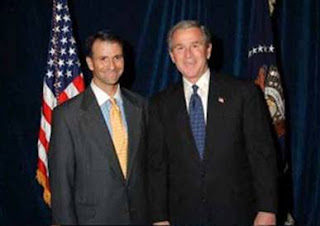 President Bush and Convicted Lobbyist Jack Abramoff
 Mission Accomplished
 The President expressing himself nonverbally
Nothing degrading to "the status of the office" of the presidency in these photos.
In a wide-ranging news conference at the White House where he touched on several major issues of the presidential campaign, Bush appeared especially animated when asked about meeting the leaders of Cuba and Iran without preconditions, an idea that has been an element of Barack Obama's foreign policy agenda.
"Sitting down at the table, having your picture taken with a tyrant such as Raul Castro, for example, lends the status of the office and the status of our country to him," Bush said. "He gains a lot from it by saying, 'Look at me, I'm now recognized by the president of the United States.' "
Tuesday, February 26
Spoken Like Someone With a 19% Approval Rating
In what many in the Blue column might call highly wishful thinking (or more strongly, delusions of grandeur), President Bush told Republican governors meeting in Washington Monday "I’m confident we’ll hold the White House in 2008. And I don’t want the next Republican president to be lonely, and that is why we got to take the House, retake the Senate, and make sure our states are governed by Republican governors.”
“Our ideas are those embraced by the American people,” Bush said to attendees of the Republican Governors Association in Washington, “the two big issues facing us: who best to protect America, and who best to keep taxes low. I’m looking forward to this campaign. I’m excited about taking our message to the American people. With your help and hard work, there’s no doubt in my mind — no doubt — that we’ll win,” he said.
He also said that, despite opinion polls showing a majority of Americans oppose the Iraq war, the public understands that the war is essential to national security. “We will elect someone in the White House who will keep up the fight to make sure Iraq is secure and free,” said Bush.
“Our ideas are those embraced by the American people,” Bush said to attendees of the Republican Governors Association in Washington, “the two big issues facing us: who best to protect America, and who best to keep taxes low. I’m looking forward to this campaign. I’m excited about taking our message to the American people. With your help and hard work, there’s no doubt in my mind — no doubt — that we’ll win,” he said.
He also said that, despite opinion polls showing a majority of Americans oppose the Iraq war, the public understands that the war is essential to national security. “We will elect someone in the White House who will keep up the fight to make sure Iraq is secure and free,” said Bush.
Thursday, February 21
We Are the American People and We Disaprove of This President
Is it any wonder that Geoorge Bush is in Africa? The American Research Group's latest poll shows that George W. Bush's job approval rating has plummeted to below 20%. a record 77% disapprove of his handling of the job, particularly the economy.
Feb 2008 19% Approve; 77% Disapprove; 4% Undecided
Jan 2008 34% Approve; 59% Disapprove; 7% Undecided
According to the ARG,
Feb 2008 19% Approve; 77% Disapprove; 4% Undecided
Jan 2008 34% Approve; 59% Disapprove; 7% Undecided
According to the ARG,
A total of 78% of Americans say the national economy is getting worse and 47% say the national economy is in a recession. A total of 42% of Americans, however, say they believe the national economy will be better a year from now, which is the highest level for this question in the past year. This optimism does not spread to improvements in household financial situations as 17% of Americans say they expect their household financial situations to be better a year from now, which is the lowest for this question in the past year.
Thursday, January 17
The Ghost of Rose Mary Woods: WH Blank Tapes
The White House, despite two Federal laws erased e-mail records of millions of communications in order by recycling the backup tapes used to store them.
Given the types of communications that likely took place between 2001 and 2003, some very important messages may have been vaporized.
According to the Washington Post
Given the types of communications that likely took place between 2001 and 2003, some very important messages may have been vaporized.
According to the Washington Post
E-mail messages sent and received by White House personnel during the first three years of the Bush administration were routinely recorded on tapes that were "recycled," the White House's chief information officer said in a court filing this week.
During the period in question, the Bush presidency faced some of its biggest controversies, including the Iraq war, the leak of former CIA officer Valerie Plame Wilson's name and the CIA's destruction of interrogation videotapes.
White House spokesman Tony Fratto said he has no reason to believe any e-mails were deliberately destroyed.
From 2001 to October 2003, the White House's practice was to use the same backup tape each day to copy new as well as old e-mails, he said, making it possible that some of those e-mails could still be recovered even from a tape that was repeatedly overwritten. "We are continuing to analyze our systems," Fratto said last night.
The court filing said tapes were recycled before October 2003, and at that point, the White House "began preserving and storing all backup tapes."
Two federal statutes require presidential communications, including e-mails involving senior White House aides, to be preserved for the nation's historical record, and some historians responded to the court disclosure yesterday by urging that the White House's actions be thoroughly probed.
Thursday, January 10
George McGovern Calls For Bush/Cheney Impeachment
From George McGovern's Sunday 1/6/08 Washington Post Op-Ed "Why I Believe Bush Must Go: Nixon Was Bad. These Guys Are Worse."
As we enter the eighth year of the Bush-Cheney administration, I have belatedly and painfully concluded that the only honorable course for me is to urge the impeachment of the president and the vice president.
After the 1972 presidential election, I stood clear of calls to impeach President Richard M. Nixon for his misconduct during the campaign. I thought that my joining the impeachment effort would be seen as an expression of personal vengeance toward the president who had defeated me.
Today I have made a different choice.
Of course, there seems to be little bipartisan support for impeachment. The political scene is marked by narrow and sometimes superficial partisanship, especially among Republicans, and a lack of courage and statesmanship on the part of too many Democratic politicians. So the chances of a bipartisan impeachment and conviction are not promising.
But what are the facts? Go to the WP for more
As we enter the eighth year of the Bush-Cheney administration, I have belatedly and painfully concluded that the only honorable course for me is to urge the impeachment of the president and the vice president.
After the 1972 presidential election, I stood clear of calls to impeach President Richard M. Nixon for his misconduct during the campaign. I thought that my joining the impeachment effort would be seen as an expression of personal vengeance toward the president who had defeated me.
Today I have made a different choice.
Of course, there seems to be little bipartisan support for impeachment. The political scene is marked by narrow and sometimes superficial partisanship, especially among Republicans, and a lack of courage and statesmanship on the part of too many Democratic politicians. So the chances of a bipartisan impeachment and conviction are not promising.
But what are the facts? Go to the WP for more
Monday, January 7
Sudan Death
With neighboring Chad involved in a undeclared war, African Union and United Nation peacekeepers difficulties to deploy troops, things in the Sudan are increasingly becoming more unstable to the point that President Bush has said, “I have been frustrated, frankly, with the pace of the United Nations and the AU to get troops in there.”
According to Fox News
Also, according to a Sudan news source,
According to Fox News
With international attention increasingly focused on other world trouble spots, the United States is boosting its profile on Sudan with the appointment of a new special envoy for the country, a former senior diplomat with links to President Bush, the GOP and a firm grasp of the U.N. system.
The envoy, Richard "Rich" Williamson, was sworn in by Secretary of State Condoleezza Rice on Monday, after his predecessor, Andrew Natsios, resigned last month. Natsios, a former administrator of the U.S. Agency for International Development, was said to have been frustrated by internal bureaucratic battles over the direction of Sudan policy.
Also, according to a Sudan news source,
a joint African-United Nations force took over peacekeeping duties in Darfur on Monday and existing AU forces switched their green berets to the UN blue ones. The transfer of authority has been largely symbolic.
Sudan not signed off on the Status of Force (SAF) agreement that governs the work of the new force. It has refused to allow night flights — except for medical evacuation — or large U.N. cargo planes.
Additionally, the government has attempted to require the force to give it advance notice of all movements and to ensure that its military can scramble U.N. radio communications when it is conducting operations.
Sudan has also refused to allow non-African units in Darfur including Swedish, Thai and Nepalese troops.
International experts estimate 200,000 people have died in the conflict, which Washington calls genocide, a term European governments are reluctant to use. The Sudan government says 9,000 people have been killed.
Friday, December 28
Orwell Would Be So Proud: Bush Vetos Defense Spending Bill
Yes, the President has done what the Democrats have failed to do. He has vetoed the 2008 Defense Spending Bill. Now this is not to be confused by the 3000 page budget which includes funding of the war efforts in Iraq and Afghanistan.
However, due to a provision that would allow Iraqis to sue the current government of Iraq in American courts for damages caused under Saddam Hussein's rule, freezing funds in American banks.
Iraq discussed with the United States the possibility of pulling its assets, about $20 billion to $30 billion, out of U.S. institutions if the defense policy bill became law, a senior administration official said on condition of anonymity.
As Steve Benen at CBS said:
"Keep in mind, the veto of the defense authorization bill puts a variety of key spending measures in limbo, including a pay raise for the troops, VA care for wounded veterans, a new "Truman Commission" to fight fraud and waste by military contractors, and expanded job protections for family members of severely wounded troops."
The White House acknowledged the veto would block an additional 0.5% pay raise for military service members authorized by the bill and said it would work to ensure that a retroactive hike is included in a revised version of the legislation. A 3% raise is already set to go into effect in 2008 without the president's signature, Stanzel said.
However, due to a provision that would allow Iraqis to sue the current government of Iraq in American courts for damages caused under Saddam Hussein's rule, freezing funds in American banks.
Iraq discussed with the United States the possibility of pulling its assets, about $20 billion to $30 billion, out of U.S. institutions if the defense policy bill became law, a senior administration official said on condition of anonymity.
As Steve Benen at CBS said:
"Keep in mind, the veto of the defense authorization bill puts a variety of key spending measures in limbo, including a pay raise for the troops, VA care for wounded veterans, a new "Truman Commission" to fight fraud and waste by military contractors, and expanded job protections for family members of severely wounded troops."
The White House acknowledged the veto would block an additional 0.5% pay raise for military service members authorized by the bill and said it would work to ensure that a retroactive hike is included in a revised version of the legislation. A 3% raise is already set to go into effect in 2008 without the president's signature, Stanzel said.
Thursday, December 20
Bush Says Immunity for Telecoms Should Be #1 Priority
From AP
Bush called on lawmakers to extend the Protect America Act when they return from vacation in January, saying the legislation "closed dangerous gaps" in collecting intelligence on terrorists overseas. But he complained that its key provisions are set to expire at the beginning of February, "as if the terrorist threat is going to go away on February the 1st, 2008."
Bush said Congress should make the bill its top priority when it returns and that it "should include liability protection for companies that are facing multibillion-dollar lawsuits only because they are believed to have assisted in the effort to defend our nation following the 9/11 attacks."
The law modified the 1978 Foreign Intelligence Surveillance Act (FISA) to allow wiretapping without a warrant from the secret FISA court when the target of the eavesdropping is a foreigner located outside the United States. The White House wants the law to protect telecommunications companies that acceded to administration requests for data.
The act is strongly opposed by civil liberties groups such as the ACLU, which charges that it "allows for massive, untargeted collection of international communications without court order or meaningful oversight by either Congress or the courts."
Bush called on lawmakers to extend the Protect America Act when they return from vacation in January, saying the legislation "closed dangerous gaps" in collecting intelligence on terrorists overseas. But he complained that its key provisions are set to expire at the beginning of February, "as if the terrorist threat is going to go away on February the 1st, 2008."
Bush said Congress should make the bill its top priority when it returns and that it "should include liability protection for companies that are facing multibillion-dollar lawsuits only because they are believed to have assisted in the effort to defend our nation following the 9/11 attacks."
The law modified the 1978 Foreign Intelligence Surveillance Act (FISA) to allow wiretapping without a warrant from the secret FISA court when the target of the eavesdropping is a foreigner located outside the United States. The White House wants the law to protect telecommunications companies that acceded to administration requests for data.
The act is strongly opposed by civil liberties groups such as the ACLU, which charges that it "allows for massive, untargeted collection of international communications without court order or meaningful oversight by either Congress or the courts."
Monday, December 17
Senate Move Ahead on FISA Bill With Immunity to Telecoms
From Reuters
President George W. Bush's demand for immunity for telephone companies that participated in his warrantless domestic spying program won an initial victory on Monday in the U.S. Senate.
On a vote of 76-10, far more than the 60 needed, the Democratic-led Senate cleared a procedural hurdle and began considering a bill to increase congressional and judicial oversight of electronic surveillance of suspected terrorists.
It includes a provision to grant retroactive immunity to any telecommunications company that took part in Bush's spying program -- surveillance without court warrants of e-mails and telephone calls of people in the United States -- begun shortly after the September 11 attacks.
Nearly 40 lawsuits have been filed accusing AT&T, Verizon and Sprint Nextel Corp. of violating U.S. privacy rights.
Backers of immunity, who include some Democrats as well many of Bush's fellow Republicans, contend companies should be thanked, not punished, for helping defend the United States.
But civil liberties advocates and a number of Democratic lawmakers argue the courts should determine if any company violated privacy rights of law-abiding Americans.
President George W. Bush's demand for immunity for telephone companies that participated in his warrantless domestic spying program won an initial victory on Monday in the U.S. Senate.
On a vote of 76-10, far more than the 60 needed, the Democratic-led Senate cleared a procedural hurdle and began considering a bill to increase congressional and judicial oversight of electronic surveillance of suspected terrorists.
It includes a provision to grant retroactive immunity to any telecommunications company that took part in Bush's spying program -- surveillance without court warrants of e-mails and telephone calls of people in the United States -- begun shortly after the September 11 attacks.
Nearly 40 lawsuits have been filed accusing AT&T, Verizon and Sprint Nextel Corp. of violating U.S. privacy rights.
Backers of immunity, who include some Democrats as well many of Bush's fellow Republicans, contend companies should be thanked, not punished, for helping defend the United States.
But civil liberties advocates and a number of Democratic lawmakers argue the courts should determine if any company violated privacy rights of law-abiding Americans.
Thursday, December 13
Dem Leadership to Cave In on War Funding--Again
How is this a winding the war down?
- Budget deal would give President Bush $70 billion in additional war funding
- Provision calling for a troop withdrawal from Iraq by end of 2008 dropped
- Legislation would be passed by end of the year
- Amount less than $200 billion requested by the president
From UPI and CNN
Democratic leaders said a budget deal containing funds for the wars in Iraq and Afghanistan is likely to pass without provisions for U.S. troop withdrawals.
Democratic lawmakers said Congress is likely to pass as much as $70 billion in war funding, but without measures calling for the redeployment of many of the U.S. troops in Iraq by the end of 2008, CNN reported Thursday.
Democratic leaders said the measure may spark controversy among the party faithful who have been outspoken against the war.
The base of the Democratic Party expressed concern of the lack of pressure exerted on U.S. President George Bush to change the Iraq policy.
Senate Republicans said they would block any budget deal that didn't contain at least some of the $200 billion in war funding requested by the Bush administration.
Democrats point to the measure as a victory that curtails the Bush administration's war effort.
"What is for sure is he will not get all $200 billion," said a senior Democratic. "Whatever number it is, it is much less than what the president asked for. For the first time in this war, he has received less than his request."
"The base will not be happy," said one senior Democratic aide, who requested anonymity to candidly discuss budget negotiations that have not been completed.
- Budget deal would give President Bush $70 billion in additional war funding
- Provision calling for a troop withdrawal from Iraq by end of 2008 dropped
- Legislation would be passed by end of the year
- Amount less than $200 billion requested by the president
From UPI and CNN
Democratic leaders said a budget deal containing funds for the wars in Iraq and Afghanistan is likely to pass without provisions for U.S. troop withdrawals.
Democratic lawmakers said Congress is likely to pass as much as $70 billion in war funding, but without measures calling for the redeployment of many of the U.S. troops in Iraq by the end of 2008, CNN reported Thursday.
Democratic leaders said the measure may spark controversy among the party faithful who have been outspoken against the war.
The base of the Democratic Party expressed concern of the lack of pressure exerted on U.S. President George Bush to change the Iraq policy.
Senate Republicans said they would block any budget deal that didn't contain at least some of the $200 billion in war funding requested by the Bush administration.
Democrats point to the measure as a victory that curtails the Bush administration's war effort.
"What is for sure is he will not get all $200 billion," said a senior Democratic. "Whatever number it is, it is much less than what the president asked for. For the first time in this war, he has received less than his request."
"The base will not be happy," said one senior Democratic aide, who requested anonymity to candidly discuss budget negotiations that have not been completed.
SCHIP Sinks, Again
Like rearranging deck chairs on the Titanic, the President and Congress are going through a dance that will keep children in need from having access to affordable health insurance.
CNN
President Bush vetoed an expansion of the federally funded, state-run health insurance program for poor children for a second time Wednesday, telling Congress the bill "moves our country's health care system in the wrong direction."
In his veto message, President Bush calls on Congress to extend funding for the current program.
In his veto message, Bush said the bill is almost a duplicate of the proposal he spiked in October.
"Because the Congress has chosen to send me an essentially identical bill that has the same problems as the flawed bill I previously vetoed, I must veto this legislation, too," he said in a statement released by the White House.
The bill would have expanded the State Children's Health Insurance Program by nearly $35 billion over five years, the same as the measure Bush vetoed October 3. Track recent and historical presidential vetoes »
The president had proposed adding $5 billion to the program and said the version he vetoed would have encouraged families to leave the private insurance market for the federally funded, state-run program.
Democratic leaders said the new version addressed Republican objections by tightening restrictions on illegal immigrants receiving SCHIP benefits, capping the income levels of families that qualify for the program and preventing adults from receiving benefits.
Though the measure had strong bipartisan support, it fell short of the two-thirds majorities needed to override a presidential veto in the House and Senate.
House Minority Leader John Boehner, R-Ohio, said Democrats were more interested in scoring political points with the veto than in reaching a compromise with Republicans.
"We could have resolved the differences in his program in 10 minutes, if the majority had wanted to resolve the differences," Boehner said. "This has become a partisan political game."
The program currently covers about 6 million children whose parents earn too much to qualify for Medicaid -- the federal health insurance program for the poor -- but who can't afford private insurance.
Democrats wanted to extend the program to another 4 million, paying for it with a 61-cent-per-pack increase in the federal tax on cigarettes.
"What a sad day that the president would say that rather than insuring [millions of] children, 'I don't want to raise the cigarette tax,' " said House Speaker Nancy Pelosi.
She called for a January 23 vote on whether to override the veto.
Meanwhile, Bush called on Congress to extend funding for the current program to keep the 6 million now covered on the rolls.
CNN
President Bush vetoed an expansion of the federally funded, state-run health insurance program for poor children for a second time Wednesday, telling Congress the bill "moves our country's health care system in the wrong direction."
In his veto message, President Bush calls on Congress to extend funding for the current program.
In his veto message, Bush said the bill is almost a duplicate of the proposal he spiked in October.
"Because the Congress has chosen to send me an essentially identical bill that has the same problems as the flawed bill I previously vetoed, I must veto this legislation, too," he said in a statement released by the White House.
The bill would have expanded the State Children's Health Insurance Program by nearly $35 billion over five years, the same as the measure Bush vetoed October 3. Track recent and historical presidential vetoes »
The president had proposed adding $5 billion to the program and said the version he vetoed would have encouraged families to leave the private insurance market for the federally funded, state-run program.
Democratic leaders said the new version addressed Republican objections by tightening restrictions on illegal immigrants receiving SCHIP benefits, capping the income levels of families that qualify for the program and preventing adults from receiving benefits.
Though the measure had strong bipartisan support, it fell short of the two-thirds majorities needed to override a presidential veto in the House and Senate.
House Minority Leader John Boehner, R-Ohio, said Democrats were more interested in scoring political points with the veto than in reaching a compromise with Republicans.
"We could have resolved the differences in his program in 10 minutes, if the majority had wanted to resolve the differences," Boehner said. "This has become a partisan political game."
The program currently covers about 6 million children whose parents earn too much to qualify for Medicaid -- the federal health insurance program for the poor -- but who can't afford private insurance.
Democrats wanted to extend the program to another 4 million, paying for it with a 61-cent-per-pack increase in the federal tax on cigarettes.
"What a sad day that the president would say that rather than insuring [millions of] children, 'I don't want to raise the cigarette tax,' " said House Speaker Nancy Pelosi.
She called for a January 23 vote on whether to override the veto.
Meanwhile, Bush called on Congress to extend funding for the current program to keep the 6 million now covered on the rolls.
Tuesday, November 13
Pentagon Budget Overages Okay, Money for Jobs, Health, Education Not So Much...
From Market Watch
President Bush vetoed legislation Tuesday funding federal health and education programs, marking the latest turn in an ongoing budget fight with the Democratic-led Congress.
President Bush vetoed legislation Tuesday funding federal health and education programs, marking the latest turn in an ongoing budget fight with the Democratic-led Congress.
"The bill is nearly $10 billion over the president's request and is filled with 2,000 earmarks. He will call on Congress to take out the pork and reduce the overall spending level and return it to him quickly," White House spokeswoman Dana Perino told reporters aboard Air Force One as Bush traveled to Indiana to deliver a speech on the budget.
Democrats said Bush lacks credibility on budget issues. The $606 billion bill -- which would provide funding for the departments of labor, health and human services, and education -- passed the House of Representatives just three votes short of a veto-proof majority.
Headlines from the War
On October 24th, the Congressional Budget Office estimated that the two wars in Iraq and Afghanistan could cost taxpayers a total of $2.4 trillion by 2017 when counting the huge interest costs because combat is being financed with borrowed money, according to a study released on Wednesday.
###
On the brighter side...
Today, Washington Post and the AFP say a new study by congressional Democrats estimates the economic costs could send the price tag of the wars in Iraq and Afghanistan ballooning to 3.5 trillion dollars by 2017, Democrats warned. This report estimates the conflicts “hidden costs,” which include oil prices, interest payments on money borrowed to pay for the wars and treating wounded veterans. "The full economic costs of the war to the American taxpayers and the overall U.S. economy go well beyond even the immense federal budget costs already reported." Through 2008, it is estimated that the combined wars will cost a family of four $20,200 in taxes.
On the brighter side...
The U.S. military is sending 3,000 soldiers home from Diyala province, the second large unit to leave Iraq as troop levels are cut after a 30,000-strong "surge" earlier this year.
Soldiers from the 3rd Brigade, 1st Cavalry Division, will not be replaced by a new unit when they leave the ethnically and religiously mixed province north of Baghdad by January, military officials said on Tuesday.
Instead, troops from the larger 4th Striker Brigade Combat Team, 2nd Infantry Division, located near Baghdad, will take over the area, said military spokeswoman Major Peggy Kageleiry. There are around 162,000 U.S. soldiers in Iraq, the Pentagon said.
About 2,200 Marines from the 13th Marine Expeditionary Unit left western Anbar province in late September under President George W. Bush's plan to cut troop levels in Iraq.
###
Monday, October 29
Bush: Irrelevant on Darfur?
George Bush has over-spent his political capital to a degree that even when he is correct on actions that should be taken, such as calling on the international community to work on a solution to the continued horrific story in Darfur, his hands are tied. The Washington Post has an important story that spells the Catch 22 out.
Essentially, it shows a world leader who understands what needs to be done, but can not muster the political clout to change the course of events. As an unnamed source says, "Bush probably does want something done, but the lack of hands-on follow-up from this White House allowed this to drift. If he says, 'There is not going to be genocide on my watch,' and then 2 1/2 years later we are just getting tough action, what gives? He has made statements, but his administration has not given meaning to those statements."
This is an extremely important lesson for the person who next occupies the Oval Office: Choose your battles carefully.
Essentially, it shows a world leader who understands what needs to be done, but can not muster the political clout to change the course of events. As an unnamed source says, "Bush probably does want something done, but the lack of hands-on follow-up from this White House allowed this to drift. If he says, 'There is not going to be genocide on my watch,' and then 2 1/2 years later we are just getting tough action, what gives? He has made statements, but his administration has not given meaning to those statements."
This is an extremely important lesson for the person who next occupies the Oval Office: Choose your battles carefully.
Monday, October 22
Bush Pushing for $42 Billion More in War Money
From CNN
The Bush administration on Monday asked for an additional $42.3 billion for the wars in Iraq and Afghanistan, bringing the 2008 request for total war funding to $189.3 billion.

The Bush administration on Monday asked for an additional $42.3 billion for the wars in Iraq and Afghanistan, bringing the 2008 request for total war funding to $189.3 billion.
President Bush says Monday he is requesting billions more for the wars in Iraq and Afghanistan.
The request comes on top of $147 billion already sought for in the wars. Most of the money goes to Iraq, which is costing the Pentagon an estimated $2 billion a week.
"Parts of this war are complicated, but one part is not -- and that is that America should do what it takes to support our troops and protect our people," President Bush said in an appearance with members of veterans groups at the White House.
Bush said the money will cover basic operating expenses, plus additional armored vehicles and countermeasures designed to protect U.S. troops from roadside bombs.
"Congress should not go home for the holidays while our troops are still waiting for the funds they need," he said.
The president also called on Congress to finish the appropriations bills that fund the Pentagon and Department of Veterans Affairs before lawmakers' holiday recess, set to begin in mid-November.
The request is bound to kick off another debate on Capitol Hill over the course of the Iraq war. Bush's last supplemental spending request led to a showdown with the Democratic leaders of Congress, who pushed for a withdrawal of American combat troops in 2008 -- a demand dropped after the president vetoed the measure.
Sunday, October 21
Why SCHIP Really Sunk
Despite the need for SCHIP (State's Children Health Insurance Program) to cover more uninsured children and pregnant mothers, this week Congress was unable to override the President's veto. The reason is abundantly clear for those who follow the train of thought that led to the veto.
If SCHIP were to be expanded, it is feared that it would be at the expense to private insurers. An article on SCHIP on Wikipedia states: In a 2007 analysis by the Congressional Budget Office, researchers determined that "for every 100 children who gain coverage as a result of SCHIP, there is a corresponding reduction in private coverage of between 25 and 50 children." The CBO speculates this is because the state programs offer better benefits and lower cost than the private alternatives.[9] A Cato Institute briefing paper estimated the "crowding out" of private insurers by the public program could be as much as 60%.[10]
The Watchdog Blog reports "Government operated health care programs such as Medicare, Medicaid and State Children’s Health Insurance Program (SCHIP) operate with far less administrative expense that the so-called “market-based” private insurance programs. In fact, private health insurers and HMOs now href="http://www.pnhp.org/physiciansproposal/proposal/Physicians%20ProposalJAMA.pdf">consume 13.6 percent of premiums for overhead while both the Medicare program and Canadian NHI have overhead costs below 3.2 percent. "
Given the amount of lobbying the insurance industry does ($227 million in the first half of 2007), it would seem the veto is a preemptive (turf protecting) strike against the "terrorist threat" of national health care being built from the foundations of SCHIP, Medicaid, and Medicare.
And, as reported in the Congressional Quarterly, "A Families USA analysis of Census Bureau data finds that more than one out of three people under age 65 — approximately 89.6 million Americans — were uninsured at some point during 2006-2007.
If SCHIP were to be expanded, it is feared that it would be at the expense to private insurers. An article on SCHIP on Wikipedia states: In a 2007 analysis by the Congressional Budget Office, researchers determined that "for every 100 children who gain coverage as a result of SCHIP, there is a corresponding reduction in private coverage of between 25 and 50 children." The CBO speculates this is because the state programs offer better benefits and lower cost than the private alternatives.[9] A Cato Institute briefing paper estimated the "crowding out" of private insurers by the public program could be as much as 60%.[10]
The Watchdog Blog reports "Government operated health care programs such as Medicare, Medicaid and State Children’s Health Insurance Program (SCHIP) operate with far less administrative expense that the so-called “market-based” private insurance programs. In fact, private health insurers and HMOs now href="http://www.pnhp.org/physiciansproposal/proposal/Physicians%20ProposalJAMA.pdf">consume 13.6 percent of premiums for overhead while both the Medicare program and Canadian NHI have overhead costs below 3.2 percent. "
Given the amount of lobbying the insurance industry does ($227 million in the first half of 2007), it would seem the veto is a preemptive (turf protecting) strike against the "terrorist threat" of national health care being built from the foundations of SCHIP, Medicaid, and Medicare.
And, as reported in the Congressional Quarterly, "A Families USA analysis of Census Bureau data finds that more than one out of three people under age 65 — approximately 89.6 million Americans — were uninsured at some point during 2006-2007.
Most of the uninsured lacked coverage for long periods of time, the study found. Nearly two-thirds were uninsured for six months or more and over half were uninsured for nine months or longer."
Given that increases in spending for SCHIP worked out to an estimated $555 per child per year, it will be a tough sell to convince American families that SCHIP is a bad plan, if for no other reason than one visit to the emergency room can easily cost that much or more.
The revamped SCHIP bill will go through this year or it will be another nail in the Republican's White House chances.
Monday, October 1
Saber Rattling: Iran in US Bombsights?
According to AFP the Bush administration has got plans on the table to "surgically" attack Iran:
The US administration has shifted strategy and is drawing up plans for possible air strikes against Iran's Revolutionary Guard instead of the country's nuclear sites, the New Yorker magazine reported on Sunday.
The US administration has shifted strategy and is drawing up plans for possible air strikes against Iran's Revolutionary Guard instead of the country's nuclear sites, the New Yorker magazine reported on Sunday.
President George W. Bush has requested the Joint Chiefs of Staff revise plans for a possible attack on Iran, with the focus on "surgical" raids against the Iranian Revolutionary Guard Corps which Washington accuses of targeting US forces in Iraq, the magazine wrote.
Previous contingency plans called for a more elaborate bombing campaign against suspected nuclear sites in Iran as well as other infrastructure, the magazine reported, citing unnamed former officials and government consultants.
The change in focus comes as Bush and his top aides have begun to describe the war in Iraq in public statements as increasingly a "strategic battle between the United States and Iran," said the article by investigative reporter Seymour Hersh.
During a video conference over the summer, Bush allegedly told Ryan Crocker, the US ambassador to Iraq, that he was considering striking Iranian targets across the border and that the British "were on board," according to the article.
Subscribe to:
Comments (Atom)